
Epoxy Coated Rebar: Proven Corrosion Protection for Concrete Structures
More than 50 years in service.
More than 80,000 bridges.
One coating standing between chloride and steel.
In Southern Exposure testing by the University of Kansas for the Kansas DOT and FHWA, epoxy-coated bar in good coating condition did not initiate corrosion until the chloride content at the bar reached 7.28 lb/yd³ of concrete (water-soluble), versus 1.58 lb/yd³ for uncoated bar — roughly 4.6 times the chloride load before corrosion initiates.
Evaluation of Multiple Corrosion Protection Systems for Reinforced Concrete Bridge Decks (published as SM Report No. 100 by the University of Kansas Center for Research, Inc.)
Authors: Matthew O’Reilly, David Darwin, JoAnn Browning, and Carl E. Locke, Jr.
(The report is based directly on the Ph.D. thesis of Matthew O’Reilly)
Sponsoring Agencies: Major funding for the research was provided by the Kansas Department of Transportation (KDOT) and the Federal Highway Administration (FHWA)
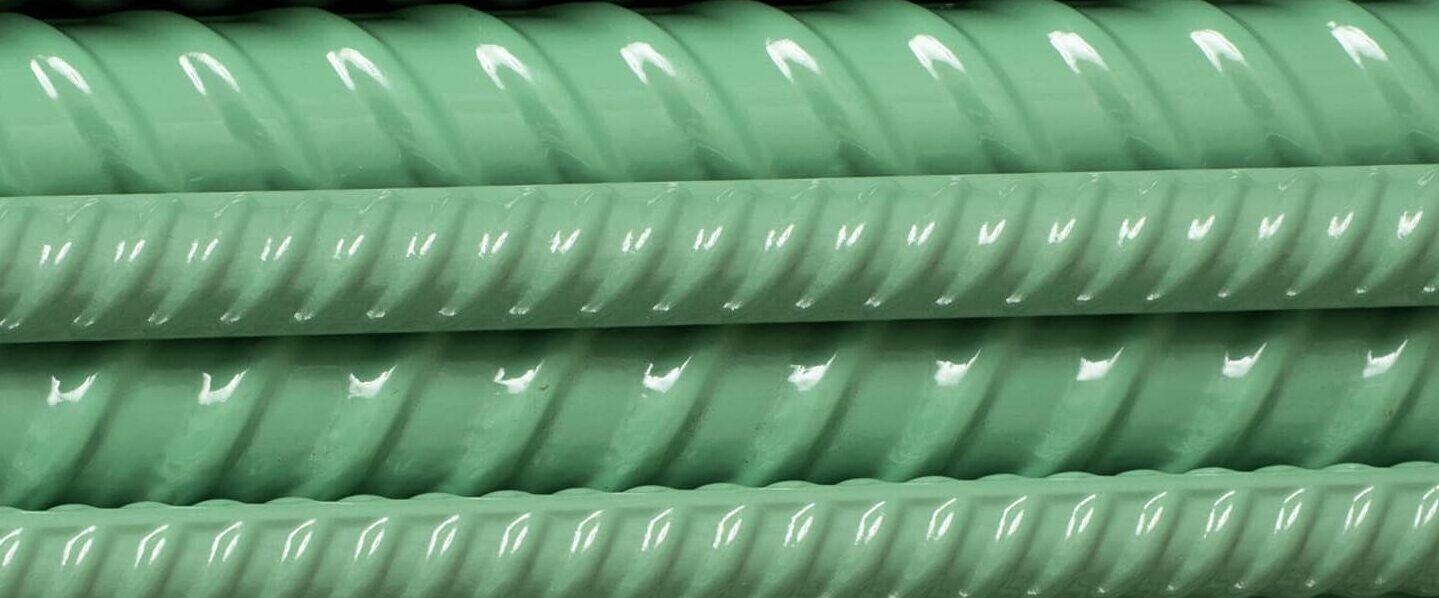
Green is the most common color, which is why the product is often called green rebar. The color comes from pigment in the epoxy powder and has nothing to do with how the coating protects the steel. A smooth green coating (ASTM A775) signifies a flexible coating designed for fabrication after being coated. Smooth purple and gray colors (ASTM A934) designate less flexible coatings designed for application after fabrication. All colors meet the same protective requirements.
Why is epoxy coated rebar green?
How Epoxy Coated Rebar Is Made
The fusion-bonded epoxy coating process runs in four steps, and every step is governed by specification.
- Surface preparation. Bars are abrasive blast-cleaned to a near-white metal finish (SSPC-SP10 / Nace no. 2), stripping mill scale, rust, and salt and leaving an anchor profile of 1.5 to 4.0 mils for the coating to grip.
- Heating. Bars are heated to approximately 450°F, usually by electrical induction.
- Powder application. The hot bar passes through a spray booth where electrostatically charged epoxy powder is applied. On contact the powder melts, flows into the anchor profile, and conforms to the ribs and deformations of the bar.
- Cure. The film hardens in roughly 30 seconds, forming a single continuous fusion-bonded coating.
Why Specifiers Choose Epoxy Coated Rebar

CORROSION PROTECTION
FHWA testing found that when both the top and bottom mats are coated, epoxy coated bars corroded 40 to 50 times less than uncoated bars. FHWA-HRT-04-090, published in 2004 by Lee and Krauss, measured mean macrocell current density in both-mat epoxy coated construction at no more than 2 percent of the highest uncoated bar case — even with coating defects present.

SERVICE LIFE
A 2010 Michigan DOT analysis of 1,790 bridge decks estimated about 70 years for epoxy coated decks to reach poor condition, against roughly 35 years for black bar.1 CRSI Research Series No. 12, prepared by Wiss, Janney, Elstner Associates across 17 decks in seven northern states, concluded that coating both mats makes an average service life extension of 82 years or more possible. 2 In West Virginia, companion black-bar decks were overlaid or rehabilitated at 18 to 21 years while the epoxy coated decks reached 33 to 35 years with no corrosion-related repair 3. Read the full service life extension research.

LIFE-CYCLE COST
A University of Kansas life-cycle cost study conducted for FHWA and the Kansas DOT compared bridge decks over a 75-year life at a 4 percent discount rate. Epoxy coated rebar added $7/yd² up front — $196 against $189 — and returned $207/yd² in avoided repair, for a 75-year life-cycle cost of $237/yd² versus $444/yd² uncoated. On three bridges studied in 1998, specifying epoxy coated bars raised total structure cost by between 0.49 and 2.16 percent. See the full life-cycle cost of epoxy coated rebar breakdown.

SUSTAINABLE
Epoxy coated bars are made using over 97 percent recycled material, primarily post-consumer, and remain fully recyclable at end of life. Manufacture and use produce no VOCs, and the coating adds virtually nothing to the weight of the bar. Recycled content and regional sourcing both contribute to LEED materials credits.

CERTIFIED QUALITY
The CRSI epoxy coating plant certification program has operated since 1991 — 37 plants across North America today — against ANSI/CRSI CG1.3-2025 and the applicable ASTM standards. Certification requires random audit at least once a year by an independent third party, covering surface preparation, cure, holiday testing, thickness measurement, and adhesion, and it is written into more than 20 state DOT specifications. The program’s effect is measurable: coating thickness variability fell 23 percent, and backside contamination dropped from 40–50 percent to 15 percent.

PROVEN AT SCALE
Epoxy coated bars have been in use since 1973, when it was first specified on a bridge in Pennsylvania. More than 80,000 bridges in the National Bridge Inventory contained epoxy coated reinforcing steel as of 2013, and over 600,000 tons are produced each year in the United States and Canada. It is the most researched corrosion protection system for reinforcing steel, with more than 200 published papers behind it. In NCHRP Synthesis 641 (2025), 73 percent of the 45 responding state DOTs reported current use and 93 percent reported experience with it.
Where Epoxy Coated Rebar is Used
Epoxy coated rebar is specified anywhere reinforced concrete meets chloride — from deicing salt, from seawater, or from both. EIG documents applications for epoxy coated rebar across six structure types.
- Bridges and bridge decks. The largest single application, and the one with the deepest performance record. Decks take the heaviest deicing salt loads of any structure type.
- Parking structures. At least $100 million is spent every year repairing parking decks in the United States, most of it traceable to winter deicing salt carried in on vehicles.4
- Marine structures. Piers, wharves, seawalls, and causeways in permanent chloride exposure.
- Pavements. Continuously reinforced concrete pavement, and dowel bars in jointed pavement. As of a 2005 survey, 26 of 33 transportation agencies were using epoxy coated dowels.
- Buildings. Below-grade parking levels, plaza slabs, and exposed balconies — an application that began in the 1980s and now covers tens of thousands of structures.
- Concrete repair. Coated bars in a patch reduce the ring anode effect that otherwise drives new corrosion at the edges of the repair.
The scale of individual projects tells the same story. The San Francisco–Oakland Bay Skyway Bridge used 30,000 tons of epoxy coated reinforcing steel against a 150-year design life, with every bar below 23 feet above sea level coated. The Indian River Inlet Bridge in Delaware used 3,000 tons on a 100-year minimum service life. The Biloxi Bay Bridge, rebuilt after Hurricane Katrina, used 11,000 tons. Browse more Project Examples across bridges, buildings, parking structures, and marine work.
Specifications and Standards
Epoxy coated bars are specified through ASTM and AASHTO standards, with design carried out under ACI 318. Bars should be purchased from CRSI-certified coating plants.
| Standard | Scope |
|---|---|
| ASTM A775/A775M | Epoxy-coated steel reinforcing bars — coating applied to straight bars, which are then fabricated. Covers coating application only. |
| ASTM A934/A934M | Epoxy-coated prefabricated steel reinforcing bars — bars bent to shape before coating. |
| ASTM D3963/D3963M | Fabrication and jobsite handling, including repair material qualification, storage, and damage limits. |
| ASTM A884/A884M | Epoxy-coated steel wire and welded wire reinforcement. |
| AASHTO M284/M284M | Coating application, fabrication, and field handling in one specification. |
| ACI 318 | Structural design, including development and splice length provisions for coated bars. |
| ANSI/CRSI CG1.3 | Basis of the CRSI Epoxy Coating Plant Certification Program. |
Two limits are worth knowing before bars reach the jobsite. Coating damage must not exceed 2 percent of bar area in any one-foot section, excluding cut ends, and patching material must not cover more than 5 percent of surface area in any one-foot section. All damage — cut ends, cracks, abrasions — is repaired with a two-part epoxy approved by the coating manufacturer. Spray-can materials cannot meet the standards and should not be used.
EIG publishes step-by-step guidance on the fabrication of epoxy coated rebar and on field handling of epoxy coated rebar, along with jobsite inspection guidelines covering acceptance and rejection criteria.
Frequently Asked Questions
How long does epoxy coated rebar last?
Epoxy coated bars are routinely specified for a 75-year design life and often for 100 years, given appropriate concrete cover, mix design, and construction quality.. A 2010 Michigan DOT study of 1,790 bridge decks estimated roughly 70 years to reach poor condition with epoxy coated rebar, against about 35 years with uncoated bar.
What is the difference between ASTM A775 and ASTM A934?
ASTM A775/A775M covers bars that are coated in a straight condition and then bent. ASTM A934/A934M covers bars that are bent to shape before coating. Both require the same testing for thickness, continuity, flexibility, and adhesion.
How much more does epoxy coated rebar cost than uncoated rebar?
Epoxy coated bars generally cost 25 to 50 percent more than uncoated bars as a material, but rebar is a small fraction of a structure’s cost — on three bridges studied in 1998, the increase was between 0.49 and 2.16 percent of total structure cost. Over a 75-year life, the University of Kansas found epoxy coated decks cost $237/yd² against $444/yd² for uncoated.
How does epoxy coated rebar compare to galvanized rebar?
In the field studies complied in EIG literature review, epoxy coated reinforcing steel has out performed galvanized in bridge deck service. Among Pennsylvania decks built between 1973 and 1983, 8.9 percent of epoxy coated decks rated below 5, versus 22.5 percent of galvanized. Adoption reflects that record: based on the 2011 Nation Bridge Inventory, more than 74,000 bridge decks use epoxy coated reinforcing steel against roughly 1,000 using galvanized. EIG’s literature review compares epoxy coated vs. galvanized reinforcing steel study by study.
Does epoxy coated rebar work in cracked concrete?
Yes. Epoxy coated bars protect even in cracked concrete. Because the coating is dielectric, coated bars are poor cathodes, which limits the corrosion cell that a crack would otherwise establish.
Does the epoxy coating affect bond strength?
The coating reduces bond somewhat, so ACI 318 applies a development-length multiplier to smooth coated bars — a known, codified factor that designers account for. ASTM A1124 textured epoxy coating was developed to close this gap. ASTM A1124 testing requirements require textured epoxy deliver bond performance equivalent to uncoated reinforcement.
How should epoxy coated rebar be stored on site?
Store bundles on timber cribbing to minimize sagging, keep coated and uncoated bars separate, and cover with an opaque material that minimizes condensation. ASTM
D3963 requires protective covering where cumulative exposure before concrete placement will exceed two months.
Can epoxy coated rebar be welded?
Yes, following AWS D1.4/D1.4M. With Coating removed from the weld zone and adjacent area before welding and properly repaired afterward. ASTM A706 bars are designed for welding without preheating; preheat for both grades is determined by carbon equivalent and bar size under AWS D1.4 and can reach 500°F. Coating damaged by welding is repaired with patch material meeting the requirements of ASTM A775 and applied per ASTM D3963
Is epoxy coated rebar environmentally friendly?
Epoxy coated bars are made using over 97 percent recycled material, primarily post-consumer, produce no VOCs during manufacture or use, and are recyclable at end of life. Recycled content and regional sourcing both contribute to LEED materials credits.
More questions are answered in EIG’s full epoxy coated rebar FAQs, covering specification, fabrication, field practice, and comparisons with other corrosion-resistant reinforcing systems.
LEARN MORE:
SEE HOW EPOXY COATED REBAR IS MANUFACTURED
Watch nowREAD THE UNIVERSITY OF KANSAS LIFE-CYCLE COST STUDY
Read hereEXPLORE EIG'S FULL RESEARCH LIBRARY
Learn moreThe Epoxy Interest Group is a not-for-profit group within CRSI serving the United States, Canada, and Mexico. Our resource library holds decades of research, field studies, and project case histories on epoxy coated reinforcing steel — including newer developments such as ASTM A1124 textured epoxy coated rebar, which delivers the bond performance of uncoated bar alongside A775 corrosion protection.